This page is for patients who have been diagnosed with thyroid Cancer and want to understand what surgical treatment involves — what total thyroidectomy means, how the voice nerve is protected, what happens to the parathyroid glands, and what advanced disease looks like in surgical terms.
Most thyroid Cancers are differentiated thyroid Cancers — meaning they arise from the thyroid follicular cells and include papillary thyroid carcinoma and follicular thyroid carcinoma. These are often highly treatable, particularly when detected early.
But when we speak of advanced thyroid surgeries, we are talking about cases that present additional complexity:
There is also a distinct and more aggressive group — medullary thyroid carcinoma and anaplastic thyroid carcinoma — that requires a different surgical strategy altogether, often with a multidisciplinary thyroid Cancer team involved from the very beginning.
What all of these cases have in common is that they demand a surgeon who does not just know how to remove a thyroid gland — but who understands the oncological behaviour of thyroid Cancer, the anatomy of the neck in three dimensions, and how to manage the unexpected findings that advanced disease so often presents.
Of all the questions patients ask before thyroid Surgery, the one I hear most often is this:
“Will I still sound like myself?”
It is entirely the right question.
The recurrent laryngeal nerve — one on each side of the neck — controls the movement of the vocal cords.
Injury to both, in rare cases of bilateral Surgery without proper technique, can cause breathing difficulty.
Recurrent laryngeal nerve preservation is not a passive aspiration — it is an active, deliberate surgical technique.
It requires identifying the nerve early in the dissection, tracking its course as it ascends from the chest toward the larynx, and maintaining its integrity throughout removal of the gland and surrounding lymph nodes.
In advanced thyroid Cancer, where the nerve may be encased in or displaced by tumour, this requires microsurgical precision and intraoperative nerve monitoring.
I use intraoperative neuromonitoring — continuous electrical monitoring of the nerve’s function during Surgery — as a standard part of every total thyroidectomy.
It provides real-time feedback, allowing me to confirm that the nerve is functioning throughout the procedure.
This is not universal practice at every centre. For me, it is non-negotiable.
The four parathyroid glands sit directly behind the thyroid, each roughly the size of a grain of rice.
They produce parathyroid hormone, which regulates the level of calcium in the blood.
When they are inadvertently removed or their blood supply is disrupted during thyroid Surgery, the result is hypocalcaemia — dangerously low blood calcium — which causes tingling, muscle cramps, and in severe cases, cardiac complications.
Parathyroid gland preservation is one of the most technically demanding aspects of total thyroidectomy.



Preserving them requires meticulous dissection technique, careful handling of their delicate blood supply, and the willingness to slow down when the anatomy is uncertain.
When a parathyroid gland cannot be preserved in situ because its blood supply has been unavoidably compromised, it can be reimplanted into the sternocleidomastoid muscle, where it will revascularise and resume function.
This is a technique I use routinely, and it significantly reduces the risk of permanent hypoparathyroidism after Surgery.
After every total thyroidectomy, I monitor calcium levels closely in the early postoperative period and supplement proactively where needed, ensuring a smooth and comfortable recovery for the patient.
Thyroid Cancer — particularly papillary thyroid carcinoma — has a well-documented tendency to spread to the lymph nodes in the neck.
This can happen even when the primary tumour is small.

The lymph nodes directly in front of and around the trachea.

The lymph nodes running along the jugular vein on one or both sides.
Central Neck Dissection
Central neck dissection involves removing the lymph node-bearing tissue in the central compartment, between the carotid arteries and from the hyoid bone down to the superior mediastinum.
It is performed routinely when there is clinical or radiological evidence of nodal disease, and selectively in high-risk tumours even when nodes appear normal on imaging.
Lateral Neck Dissection
Lateral neck dissection involves removing lymph nodes along the jugular chain when there is confirmed or suspected disease in the lateral compartment.
This is a more extensive operation requiring careful preservation of:
Jugular vein
Accessory nerve — responsible for shoulder movement
Phrenic nerve — involved in breathing
In my practice, central and lateral neck dissection is performed as part of the same operative session as the total thyroidectomy wherever possible, avoiding the need for a second Surgery and ensuring the most complete oncological clearance from the outset.
Some of the most complex cases in any thyroid Surgery practice involve patients who have already been treated — who have had a previous thyroidectomy, who have received radioactive iodine therapy, and in whom the Cancer has come back, either in the neck or in distant sites.
Advanced and recurrent thyroid Cancer Surgery is technically demanding in a way that primary Surgery is not.

Managing these cases requires not just surgical skill, but surgical judgement — knowing when to operate, what can be safely resected, when to involve other specialists, and when radiation or systemic therapy offers more than another operation.
This is the kind of nuanced, case-by-case decision-making that comes only from dedicated subspecialty training and a practice built specifically around head and neck Oncology.
As Karnataka’s first advanced thyroid surgeon with a formal head and neck Oncology background, I take on recurrent and reoperative thyroid cases that other centres may not.
These patients deserve a clear oncological plan — and I work with a full multidisciplinary thyroid cancer team to provide one.
For appropriately selected patients — those with smaller tumours, no evidence of nodal disease, and favourable anatomy — minimally invasive thyroid Surgery offers the same oncological outcome as conventional open Surgery, with a significantly smaller incision and faster recovery.
Modern minimally invasive thyroid Surgery uses a short, carefully placed incision — often less than three centimetres — positioned in a skin crease so that the healing scar is practically invisible within months of the operation.
In selected cases, video-assisted or remote access approaches allow surgery through even smaller incisions, though the standard short-scar technique remains the most widely applicable.
Minimally invasive Surgery is not appropriate for every patient.
Advanced tumours, large goitres, significant nodal disease, and certain anatomical factors may require a more conventional approach to ensure complete resection.
Imaging
Biopsy findings
Tumour characteristics
Patient anatomy
Overall clinical picture
The decision is based on what provides the safest and most complete Cancer Surgery — never on scar size alone.
Total thyroidectomy creates the conditions for radioactive iodine therapy — one of the most effective adjuvant treatments available in Oncology.
Because thyroid cells are uniquely able to absorb iodine, radioactive iodine can be administered after Surgery to destroy:
Radioactive iodine therapy is typically recommended for intermediate and high-risk differentiated thyroid Cancers, including:
It is administered as a single oral dose, usually six to twelve weeks after Surgery, once thyroid-stimulating hormone levels have been sufficiently elevated to maximise iodine uptake.
The decision about whether radioactive iodine therapy is appropriate, and at what dose, is made jointly by the head and neck Oncology surgeon, nuclear medicine physician, and endocrinologist.
This is another reason why a multidisciplinary thyroid Cancer team approach produces better outcomes than any single specialist working alone.
Thyroid Cancer — even when it appears straightforward — is never a single-specialty diagnosis.
The best outcomes in thyroid Cancer consistently come from centres where every patient is reviewed by a multidisciplinary team before treatment begins.
Head & Neck Oncology Surgeon
Endocrinologist
Nuclear Medicine Physician
Radiation Oncologist
Radiologist with expertise in neck imaging
Pathologist experienced in thyroid cytology and histopathology
Clinical Nurse Specialist
Staging is complete
Radioactive iodine indications are appropriately assessed
Hormonal requirements after Surgery are planned
Indications for targeted therapy are identified
External beam radiation requirements are considered
In my practice, every patient with thyroid Cancer is discussed at a multidisciplinary tumour board.
The plan that emerges is one that every member of the team has reviewed — and one that I am confident gives each patient the best possible chance of a good outcome.
We Are Here To Help With Your queries !
+91 95355 47980

A hemithyroidectomy removes only one lobe of the thyroid gland. It may be appropriate for very small, low-risk thyroid cancers confined to one lobe.
A total thyroidectomy removes the entire gland and is the standard for most thyroid cancers of significant size, bilateral disease, aggressive histology, or when radioactive iodine therapy is planned after surgery.
Yes. After total thyroidectomy, the body can no longer produce thyroid hormone, and lifelong thyroid hormone replacement — typically levothyroxine — is required.
In thyroid cancer patients, the dose is often adjusted to keep TSH levels slightly suppressed, reducing the stimulus for any residual cancer cells to grow.
This is managed by your endocrinologist in close coordination with the surgical team.
Most patients are discharged within one to two days after total thyroidectomy.
Return to light activity is usually possible within one to two weeks.
Strenuous activity and heavy lifting are avoided for four to six weeks.
The healing scar continues to mature and fade over six to twelve months.
For differentiated thyroid cancers — papillary and follicular — the prognosis is excellent, even in advanced stages.
The vast majority of patients treated with total thyroidectomy, appropriate neck dissection, and radioactive iodine therapy where indicated achieve long-term remission.
Medullary thyroid carcinoma is also frequently curable with surgery when detected before widespread spread.
Anaplastic thyroid carcinoma is the exception — it is aggressive and requires immediate, intensive multidisciplinary treatment.
If you or someone you love has questions on Cancer, please feel free to reach out to ARC Cancer Hospital — our team of Cancer specialists will make time to answer your questions and help you find the clearest path forward.
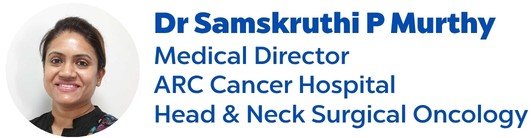
Dr Samskruthi P Murthy | Head & Neck Oncology Surgeon | ARC Cancer Hospital, Bengaluru, Karnataka