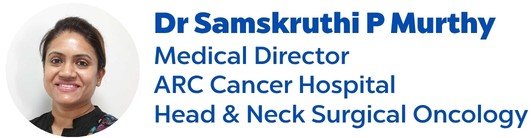
This page is for everyone who wants to understand what advanced oral cavity Cancer means, how it is treated surgically, and what specialist care looks like when it is done right.
The oral cavity includes:
Cancer can arise in any of these structures.
When we call oral cavity Cancer “advanced,” we typically mean that the tumour:
In clinical terms, advanced oral cavity Cancer usually refers to Stage III or Stage IV oral cavity squamous cell carcinoma — the most common type of oral Cancer we treat.
In India, the overwhelming majority of oral cavity Cancers are squamous cell carcinomas, and they are often diagnosed at a later stage because early symptoms are subtle and easily dismissed.
This is precisely why access to a specialist in head and neck Oncology matters so much. The decisions made at the time of the first Surgery have a direct impact on survival, function, and quality of life.
Surgical resection — the surgical removal of the tumour — remains the cornerstone of treatment for advanced oral cavity Cancer.
The goal is always to achieve clear margins: to remove the Cancer in its entirety, with a boundary of healthy tissue around it, so that no disease is left behind.
In advanced cases, this is rarely a small or straightforward procedure.
The Surgery must therefore be carefully planned to ensure complete removal while preserving as much normal tissue and function as possible.
In my practice, every surgical resection begins with a thorough preoperative assessment — reviewing imaging, staging scans, and biopsy results — to understand exactly where the tumour begins and ends.
Intraoperative decisions are then guided by the principle that complete removal is non-negotiable.
I never compromise on surgical margins.
The lymph nodes in the neck are the first place oral cavity Cancer tends to spread.
Even when a scan does not show obvious nodal disease, the risk of microscopic spread is significant in advanced tumours — and leaving it untreated is a leading cause of Cancer recurrence.
Neck dissection — the surgical removal of the lymph nodes in the neck — is therefore a critical part of managing advanced oral cavity Cancer.

Targeting specific groups of lymph nodes at the highest risk.

A more comprehensive removal of lymph nodes when the extent of disease requires it.
I perform neck dissection as a routine and integral part of advanced oral cavity Surgery, not as an afterthought.
In many cases, both sides of the neck require treatment — and this is planned into the surgical strategy from the outset.
In a significant proportion of advanced oral cavity Cancers, the tumour abuts or invades the jawbone — the mandible.
When this happens, Surgery must include mandibular resection: removal of the involved portion of the jaw.

Only the inner surface of the jaw is removed, preserving the continuity of the jawbone.

A full segment of the jaw is removed. This is a major surgical step that requires reconstruction.
Mandibular resection and reconstruction is one of the most technically demanding aspects of head and neck Surgery.
It demands not just oncological precision, but reconstructive expertise — because restoring the jaw is essential to restoring a patient’s ability to eat, speak, and regain their appearance.
When Surgery removes a significant portion of the mouth, tongue, floor of the mouth, or jaw, reconstruction is not optional — it is essential.
The patient’s ability to swallow, speak, and maintain their facial form depends on how well the surgical defect is rebuilt.
Free flap reconstruction is the gold standard technique for complex oral cavity defects.
It involves taking tissue — along with its own blood supply — from another part of the body and transferring it microsurgically to reconstruct the mouth and jaw.
Fibula Free Flap
Tissue and bone from the lower leg can be used for bony reconstruction, particularly when the jaw needs to be rebuilt.
Radial Forearm Free Flap
Tissue from the wrist/forearm area can be used to reconstruct soft-tissue defects.
This is microsurgery: the blood vessels of the flap are connected to vessels in the neck under an operating microscope, restoring circulation to the transferred tissue.
It requires specialised training, and the results — when done well — can be transformative.
As a head and neck Oncology surgeon trained in microvascular reconstruction, I perform free flap reconstruction as part of the same surgical procedure as the tumour removal.
The patient wakes up with the Cancer removed and the defect already rebuilt.
This integrated approach reduces recovery time and gives patients the best functional and aesthetic outcomes.
Surgery is often the first step, not the last.
In advanced oral cavity Cancer, a significant proportion of patients will benefit from adjuvant chemoradiotherapy — treatment with radiation and chemotherapy given after Surgery.
Close or positive surgical margins
Spread to multiple lymph nodes
Extracapsular extension — where Cancer breaks through the wall of a lymph node
Perineural invasion
Lymphovascular invasion
When these high-risk features are present, radiation alone or concurrent chemoradiotherapy — most commonly with a cisplatin-based regimen — significantly reduces the risk of recurrence.
I work closely with radiation oncologists and medical oncologists to ensure that every patient who needs adjuvant chemoradiotherapy receives it promptly after Surgery, with a coordinated treatment plan in place before the patient leaves the hospital.
Advanced oral cavity Cancer is never treated by one doctor working alone.
The best outcomes come from a multidisciplinary treatment approach — a tumour board where specialists review every case together and agree on a treatment plan before the first incision is made.
Multidisciplinary Team
Head & Neck Oncology Surgeon
Radiation Oncologist
Medical Oncologist
Radiologist
Pathologist
This is not a bureaucratic formality.
It is how we catch things that might otherwise be missed:
In my practice, multidisciplinary treatment planning is the standard of care.
Every patient with advanced oral cavity squamous cell carcinoma is discussed at a tumour board. The plan that emerges is one that every specialist on the team has reviewed and endorsed.
This is the question patients ask most, and the one I take most seriously.
Advanced oral cavity Surgery does affect function.
Ability to swallow
Speech clarity
Appearance
These are real consequences, and I believe in being honest about them from the very first consultation.
But I also believe — and my patients’ experiences confirm — that quality of life after Surgery can be remarkably good when the Surgery is planned and executed well, and when reconstruction is done at the same time as resection.
With appropriate rehabilitation — including speech therapy, swallowing therapy, and dietary support — most patients return to eating, speaking, and living their lives.
My goal is never just to remove the Cancer. It is to give each patient the best possible life after Cancer.
That means thinking about reconstruction before I think about resection, and planning the entire surgical journey with function and dignity at the centre.
I am Karnataka’s first specialist in head and neck Oncology Surgery — a distinction I carry with a sense of responsibility, not merely pride.
Head and neck Oncology is a narrow and deeply specialised field, and patients in this region have historically had to travel far to access specialist care.
Complete surgical resection with clear margins, every time.
Free flap reconstruction integrated into the primary Surgery, not as an afterthought.

Honest conversations, realistic expectations, and a team around you from diagnosis to recovery.
Whether you are a patient seeking an opinion, a family member trying to understand your options, or a referring physician looking for a specialist to trust with your most complex cases — I welcome the conversation.
We Are Here To Help With Your queries !
+91 95355 47980

Yes, in many cases.
Advanced oral cavity squamous cell carcinoma — even Stage III and Stage IV disease — is potentially curable with surgery, particularly when combined with adjuvant chemoradiotherapy where indicated.
Early specialist referral and complete surgical resection are the most important factors.
Most patients spend 10–14 days in hospital after major oral cavity surgery with free flap reconstruction.
Return to eating and speaking varies — many patients begin swallowing fluids within the first week.
Full functional recovery, with speech and swallowing therapy, typically unfolds over three to six months.
Not every patient does.
The decision depends on the pathology report after surgery — specifically, whether there are high-risk features such as positive margins, extracapsular nodal spread, or perineural invasion.
This is discussed in detail during multidisciplinary treatment planning.
Absolutely — and I encourage it.
Advanced oral cavity cancer surgery is a major undertaking, and every patient deserves confidence in their surgical plan.
Consultations to answer your queries, confusions, and improve awareness are welcome.
If you or someone you love has questions on Cancer, please feel free to reach out to ARC Cancer Hospital — our team of Cancer specialists will make time to answer your questions and help you find the clearest path forward.
Dr Samskruthi P Murthy | Head & Neck Oncology Surgeon | ARC Cancer Hospital, Bengaluru, Karnataka